🎹 The Pianist – The Music of Survival in a World at War
“I don’t know how to thank you. I’m not a very good Jew.”
“You’re not a very good pianist.”
Few films manage to depict horror with such elegance, suffering with such subtlety, and survival with such silence as Roman Polanski’s The Pianist (2002). Based on the autobiography of Władysław Szpilman, a gifted Jewish pianist in Warsaw during World War II, the film doesn’t just recount historical atrocities — it immerses you in them. With Adrien Brody’s unforgettable performance and Polanski’s restrained but powerful direction, this movie is a deeply personal story of endurance, music, and the human will to live.
🎬 A Story of Loss, Silence, and Sound
Władysław Szpilman (played by Adrien Brody) begins the film as a successful concert pianist, living comfortably with his family in 1939 Warsaw. But as Nazi Germany invades Poland, Szpilman’s world collapses. The Jewish population is forced into ghettos, robbed of rights, dignity, and eventually their lives. Szpilman’s family is deported to a concentration camp — he survives by chance, slipping through the cracks of an increasingly cruel world.
What follows is not a traditional war movie, but a deeply intimate portrait of survival. Szpilman hides in ruined buildings, starves for weeks, and watches humanity disintegrate around him. But amid the devastation, one thread keeps him alive — music. Even when he cannot play, the memory of it sustains him.
🎭 A Performance of Profound Stillness
Adrien Brody delivers a performance that doesn’t need many words. His eyes, body language, and silence convey what dialogue cannot. For much of the movie, Szpilman says very little, yet we are with him every second — feeling his hunger, fear, loneliness, and occasional flickers of hope.
Brody’s dedication was total — he lost over 30 pounds and gave up his apartment, car, and relationship to emotionally immerse himself in Szpilman’s life. The result? A performance that earned him the Academy Award for Best Actor — the youngest man ever to win in that category.
🎼 Music as Memory and Meaning
Music is not just Szpilman’s profession — it’s his soul. The film opens with him performing Chopin live on the radio as bombs fall outside. That performance is cut short, just as his life is.
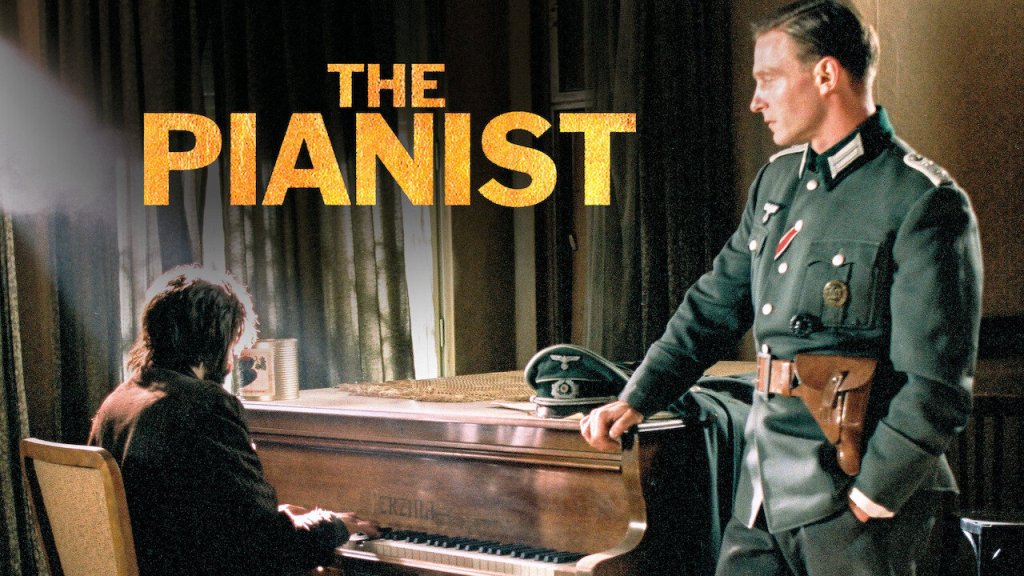
Throughout the film, music plays a ghostly role — heard through closed windows, in memory, or imagined in moments of despair. The most iconic scene comes near the end, when a German officer asks Szpilman, ragged and starving, “What do you do?” Szpilman responds simply, “I’m a pianist.” The officer points to a battered piano and says, “Play something.”
What follows is one of the most emotional scenes in film history — not just a performance, but a declaration of humanity. Szpilman plays not for survival, but for the soul of a dying world.
🧨 War Without Glory
Roman Polanski, himself a Holocaust survivor, directs the film with emotional clarity and restraint. There are no overdramatized heroics, no slow-motion gunfights. The violence is sudden, sharp, and real. We see people shot in the street, thrown from balconies, or collapsing from hunger. The camera doesn’t look away — and neither can we.
Unlike many war films that focus on combat, The Pianist focuses on the absence of life — the long, cold silence of waiting, hiding, and slowly losing everything. That silence is more terrifying than gunfire.
💔 Memorable Quotes That Echo
- “I’m a pianist.” – simple, defiant, and deeply human.
- “This is where we used to live. Now it’s rubble.”
- “Why did I do it?” – spoken by the German officer who helps Szpilman, revealing unexpected humanity.
Each line is sparse, yet loaded with meaning.
🌱 Life Lessons from The Pianist
1. Survival is not always heroic — sometimes it’s quiet and invisible.
Szpilman doesn’t fight with guns or speeches. He survives by hiding, running, and enduring.
2. Art can keep the soul alive.
Even when music cannot be heard, its memory sustains Szpilman. His identity as a pianist keeps him grounded.
3. People are not black and white.
Even in war, there are moments of unexpected kindness — like the German officer who feeds and shelters Szpilman.
4. Silence can speak volumes.
The film’s minimal dialogue forces us to pay attention to expressions, atmosphere, and unspoken pain.
5. Never underestimate the human will to live.
Szpilman survives bombings, starvation, and isolation. His endurance is a quiet triumph.
🌟 Final Verdict
The Pianist is not an easy watch — and it shouldn’t be. It’s painful, poetic, and profoundly powerful. It’s a film that shows the Holocaust not just through events, but through one man’s slow, silent suffering.
Yet it’s also a celebration — of music, of life, and of the fragile hope that survives even in the darkest times.
Rating: 10/10. A must-watch for anyone who believes in the power of art, memory, and resilience.
📚 Vocabulary and Expressions
Here are 15 useful words and expressions from the review. Each is suitable for learners and includes two example sentences.
1. Haunting – difficult to forget; deeply emotional
- The haunting melody stayed in my mind all day.
- Her eyes had a haunting sadness.
2. Collapse – to fall down or break apart suddenly
- The building collapsed after the earthquake.
- His health collapsed due to stress.
3. Survive – to stay alive in difficult conditions
- He survived three days in the desert.
- Many people did not survive the war.
4. Devastation – extreme destruction and sadness
- The war left the city in devastation.
- She felt devastation after the news.
5. Immersive – deeply involving or absorbing
- The game has an immersive storyline.
- The film’s immersive atmosphere kept me hooked.
6. Silent – without speaking or sound
- The room was completely silent.
- He gave her a silent look of understanding.
7. Willpower – strong determination to do something
- It takes willpower to quit smoking.
- Her willpower helped her finish the marathon.
8. Sustain – to support or keep alive
- Water sustains life.
- Music sustained him through hard times.
9. Restraint – holding back emotions or actions
- He showed great restraint during the argument.
- The director’s restraint made the film more powerful.
10. Tragedy – a very sad event
- Losing his family was a great tragedy.
- The movie is based on a true tragedy.
11. Humanity – kindness and care for others
- The doctor showed great humanity.
- Even in war, humanity still exists.
12. Rubble – broken pieces from a destroyed building
- They walked through the rubble after the bombing.
- The house was reduced to rubble.
13. Intimate – deeply personal or private
- They had an intimate conversation.
- The film gives an intimate view of his life.
14. Echo – to repeat a sound or idea
- Her voice echoed in the empty room.
- His words echoed in my mind for days.
15. Defiant – showing resistance or boldness
- The child gave a defiant look.
- His defiant words showed his courage.
236. The Great Flood: When Survival Is No Longer Enough
The Great Flood is a thought-provoking film set in a climate-collapsed future, emphasizing the long-term consequences of inaction rather than sudden disasters. It explores themes of survival, fragile safety, and moral dilemmas faced by characters under pressure, ultimately prompting viewers…
Keep reading
235. BUSINESS ENGLISH SERIES #5 – 5 Essential Expressions for Professional Emails and Follow-Ups
The post highlights five essential expressions for crafting professional emails. These phrases—”I’m reaching out to,” “Just following up on,” “Please let me know if,” “As discussed,” and “Looking forward to”—enhance clarity, politeness, and professionalism. Mastering them improves communication in the…
Keep reading
234. BUSINESS ENGLISH SERIES #4 – 5 Essential Expressions for Meetings and Professional Discussions
🧩 BUSINESS ENGLISH SERIES #4 5 Essential Expressions for Meetings and Professional Discussions Meetings are where decisions are made, ideas are evaluated, and leadership is noticed.Many professionals understand English well, but during meetings they hesitate, stay silent, or use language…
Keep reading
- A1 Level (2)
- A2 Level (6)
- AI – Artificial Intelligence (6)
- B1 Level (9)
- B2 Level (2)
- Biographies (16)
- Book Summaries (39)
- Business (2)
- Business English (5)
- C1 Level (1)
- C2 Level (1)
- Character (3)
- Dialogues (3)
- Did you know? (1)
- Emotion (3)
- Expressions in Songs (8)
- Finance (5)
- General Knowledge (2)
- Health (9)
- Health and Fitness (3)
- Holiday (4)
- Ideologies (1)
- Idiomatic Expressions (58)
- Food (3)
- Interesting Stories (1)
- Learning Strategies (1)
- Movie (9)
- Movie Quotes (1)
- Movie Reviews (15)
- Music (18)
- Music Review (7)
- Music Theory (1)
- News (8)
- Parenting (5)
- personal development (1)
- Politics (4)
- Power (19)
- Procrastination (2)
- Quotes (1)
- Relationship (5)
- Respect (3)
- Sexual Violence (2)
- Shopping (13)
- Social Media (8)
- Stories (1)
- Technology (5)
- Travel (10)
- Uncategorized (9)
- Unity (1)
- Vocabulary Enrichment (9)
- War (4)
 Learn With Spring Reader
5 responses to “227. The Pianist – The Music of Survival in a World at War”
Thanks LWSR for this movie review
LikeLike
art can keep the soul alive
That ‘s true.
Among these haunting news in ph
otos an videos this is the way how we keep moving and not giving up.
LikeLike
thanks LWSR for movies reviews
LikeLike
👍👍👍👍👍👍👍👍👍
LikeLike
Tha Pianist
This film tells us about humanity during war
LikeLike